

Farisita Post Office in 1960
(Santos Abel Medina)
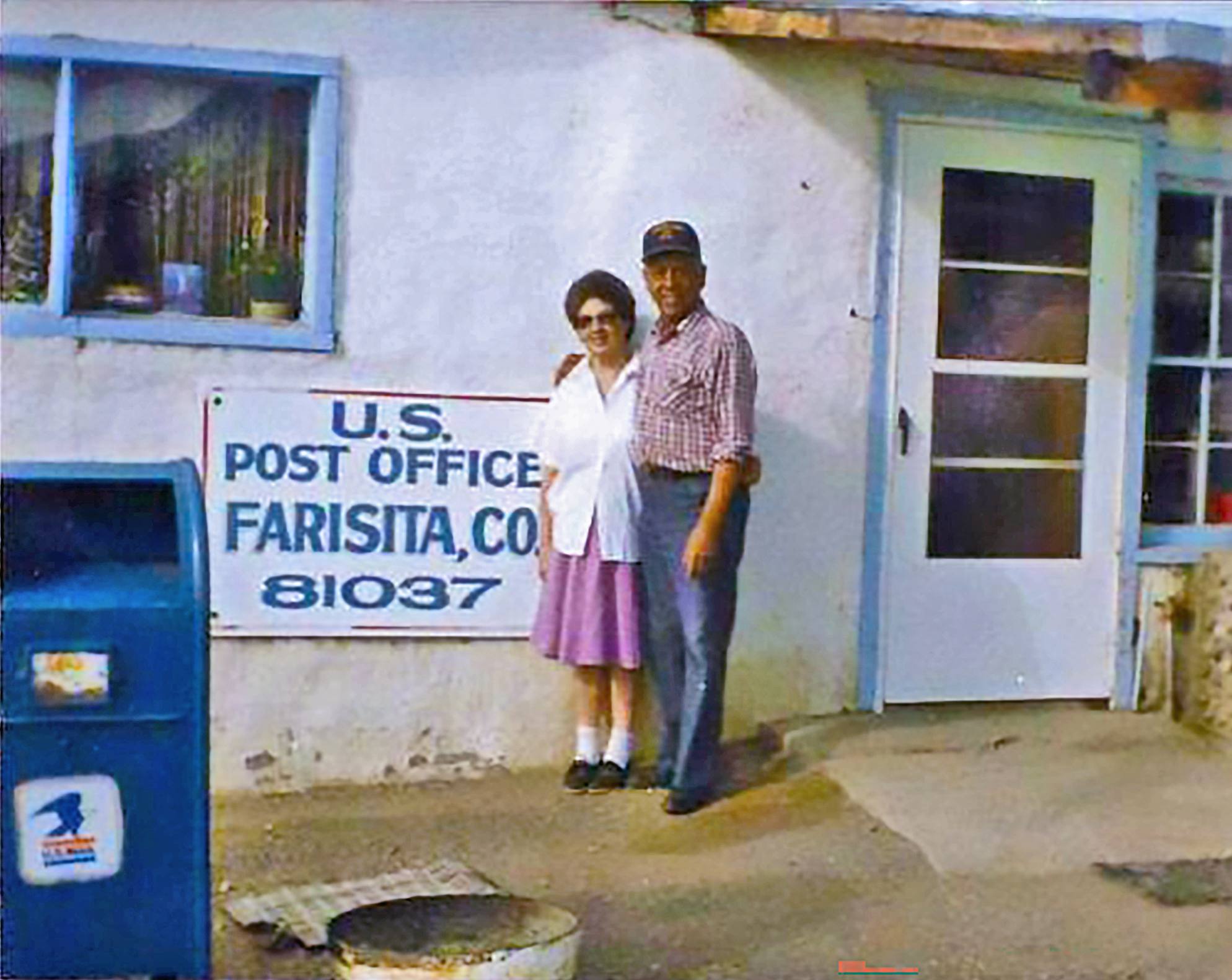
Farisita Post Office in 1982
(Ersie and Santos Abel Medina)
My childhood unfolded in Farisita during the 1960s and 70s - a time steeped in simplicity and rich with personal connections. Nestled in rural southern Colorado, Farisita was more than a mere spot on a map, it was the heartbeat of our rural community. During my years at home, my parents, Abel and Ersie Medina, were the soul of Farisita. Known across local areas from Chama to Gardner, and from Turkey Creek to Yellowstone, Abel and Ersie were a friendly presence. They never met a stranger and always extended a warm welcome to everyone. Farisita was where you stopped to pick up your mail, fill up on gas, grab some snacks, or sit and chat with neighbors who were spread far and wide. Dad (Abel) managed a welding and repair shop alongside a Phillips 66 gas station, while Mom (Ersie) took care of the post office and a small grocery store.
But this pitstop was more than just a place for mail or gas - it was a hub for community gatherings. Our home was always filled with relatives and friends and their absence was the only oddity ever.
The story of Farisita’s name, originally known as Talpa, is deeply intertwined with its history. In the early 1900s, Asperidon Faris, the postmaster at the time, faced a naming conflict with another town named Talpa in New Mexico. This town name duplication often resulted in misdirected mail. Prompted by the United States Postal Service to choose a new name, Asperidon was inspired to name the town Farisita by his Mexican housekeeper who affectionately nicknamed his daughter, Jeanette, "La Farisita." This is how it has been told. I have
"My theory is that Farisita was named so when the Faris' housekeeper, a Mexican lady, referred to little Jeanette as 'La Faris Hita.'"different theory. A term used in southern Colorado and northern New Mexico is the endearing term "hita" and "hito" for young chidren. I believe the lady was saying "La Faris hita" (The Faris’ little girl) which sounded a lot like Farisita. Louis Faris: How One Woman's Strength Shaped Farisita
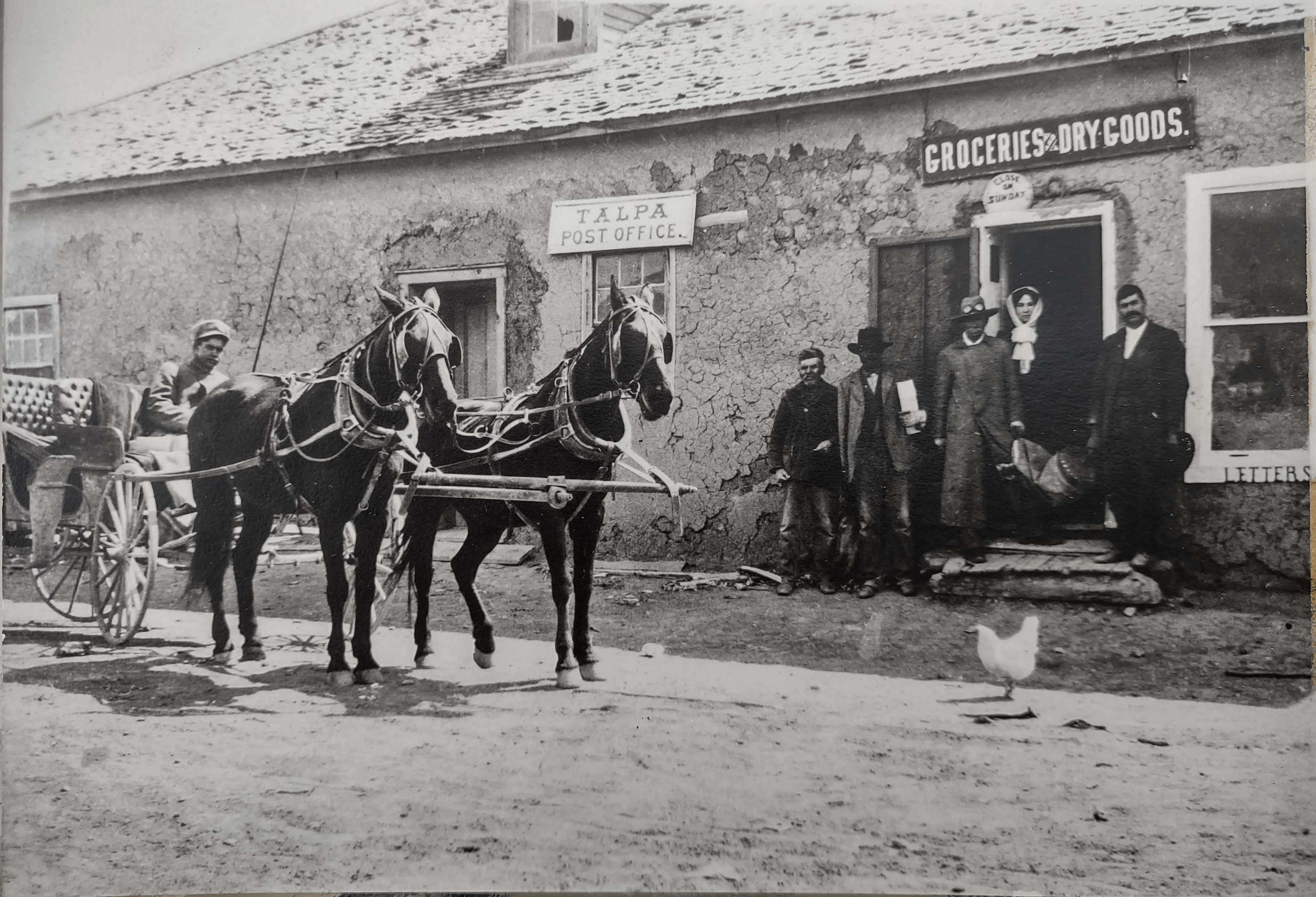
Talpa Post Office in 1912
(San Juan Ulibarri, Evaristo Aguirre, ?, Rebecca Sears, Asperidon Faris)
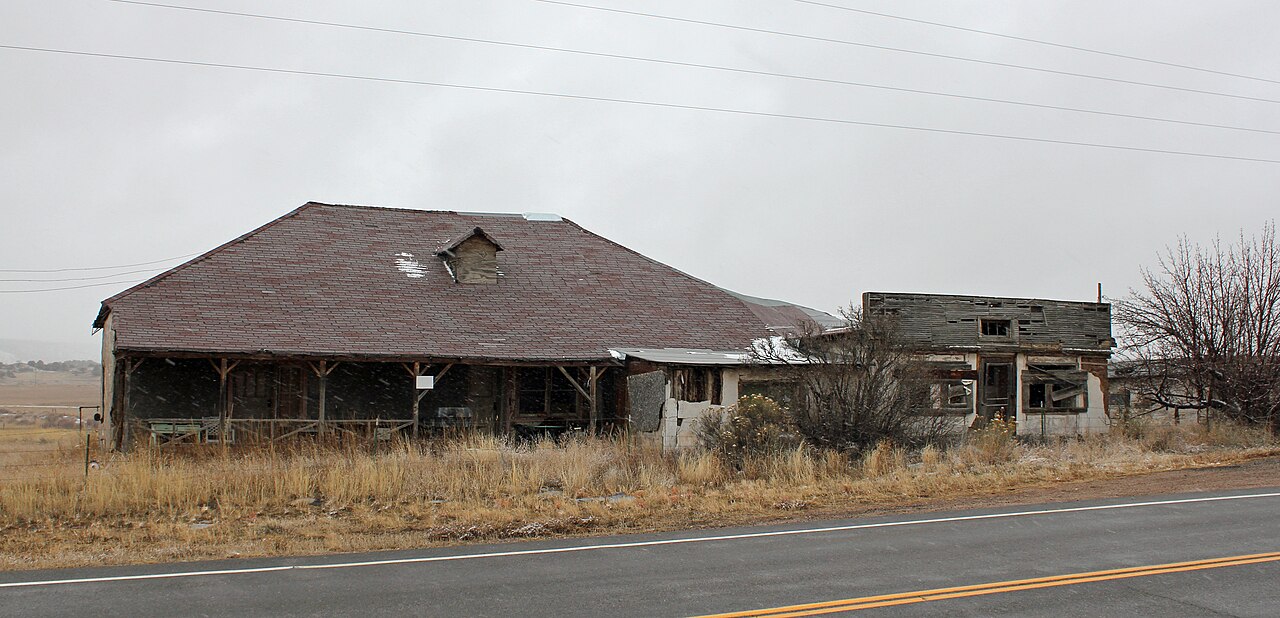
The Talpa/Montoya Ranch adobe building still stands today.
"The original Talpa store was made of adobe with a full basement. I read where this was the only known adobe building with a full basement, but my uncle Augustine Garcia also had an adobe house with a full basement which I helped a little with building (in the 1970s), so who knows."
The area once broadly known as Huerfano Cañon was renamed to Talpa. This change was an attempt to create a distinct identity and avoid postal confusion with other places named Huerfano. Ironically, this attempt to sidestep confusion inadvertently created a new one: Talpa, New Mexico had already claimed the name. The choice of "Talpa," which translates from Spanish to "mole," was likely inspired by the local area's mining activities. Moles, known for their burrowing, symbolized the industrious spirit of members of the community who worked extensively in local coal mines to create this thriving area.
This renaming was part of a broader movement during the late 19th and early 20th centuries across southern Colorado, where communities rebranded to reflect their growing independence and unique characteristics. By moving away from the name Huerfano Cañon, Talpa sought to strengthen its identity and uniqueness while also making sure the post office could correctly deliver the mail. This period marked a significant evolution in the area's history, and this story humorously highlights the challenges of naming towns in an expanding postal system. The journey from Huefano Canon to Talpa to Farisita finally resolve the postal mix-ups and further defined the uniqueness of our little community.
Settled in the picturesque southern Colorado landscape, Huerfano Cañon was a cradle of early American frontier life. The area became a crucial hub for Native American tribes, Spanish explorers, and American settlers. Its strategic location made it a vibrant center for trade, travel, and communication, located between the merging of the Huerfano River and Turkey Creek which were vital for agriculture and daily sustenance.
As the community evolved, Huerfano Cañon's need for a unique identity necessitated a name change, leading to its renaming to Talpa to reduce confusion with the broader Huerfano County. This transformation marked its transition from a loosely connected group of homesteads into a more defined community, complete with its own post office established on April 15, 1878, by William Harmes. Harmes, a German native and a pillar of the community, not only served as postmaster but also took roles as a merchant, county commissioner, and president of the local school board. He and his family were deeply embedded into the local fabric of the community. Other prominent family in the community at the times were the Sears.
The Cañon's history is marred by tragedy and misunderstandings. The diphtheria epidemic of 1893 hugely devastated the Harmes and Sears families and their neighbors, claiming the lives of many young and old alike. The fragility of life in the Cañon was further underscored in 1898 when a tragic misunderstanding led to William Harmes being fatally shot by his son August. The original story was that August mistook his dad, William, for a burglar during an outbreak of store burglaries. Uncover the truth behind this family tragedy.
These somber events painted a stark picture of the challenges faced by the early settlers, battling not only the elements but also the perils of isolation and misunderstanding. Yet, through these adversities, Huerfano Cañon's spirit of resilience and community shone through. This fostered a legacy of survival and endurance that would echo through its history as it transformed into Talpa and later Farisita.
Prior to Huerfano Cañon it was called Montoya Ranch. Check out this YouTube video: CBS News 4 - An Attempt to Save An Important Building in Farisita's History
— Mark Medina
| Year | Event Summary |
|---|---|
| 2012 | Montoya Ranch was officially recognized for its historical and architectural significance by being listed on the National Register of Historic Places. This recognition reflects the ranch's enduring legacy as a historical site, encapsulating the Spanish Colonial and territorial architectural styles that were prevalent among early settler constructions in the region. This landmark has served as a crucial piece of cultural heritage, representing the early days of Hispanic settlement along the Huerfano River, where communities flourished through agriculture and ranching. |
| 2008 | The former community known as Farista was annexed by the city of Walsenburg, reflecting a broader trend of urban expansion and administrative consolidation in the region. This transition led to the area being renamed the Northlands neighborhood, which marked the end of the independent identity of Farista as a separate community. This change symbolizes the evolving landscape of rural communities as they become absorbed into larger municipal entities, reflecting ongoing changes in demographics, governance, and regional planning. |
| 2000 | Montoya Ranch, having fallen into disrepair, was purchased by a Taos art dealer who initiated restoration efforts. These efforts were driven by the dealer's appreciation for the ranch's unique historical and architectural features, which include the only known full adobe basement in Colorado or New Mexico. The restoration aimed to preserve these unique structural elements and ensure that the ranch could serve as a testament to the region's rich cultural and architectural heritage for future generations. |
| 1990 | In a significant shift for the community, the United States Postal Service retired the 81037 zip code, formally marking the cessation of Farisita as an official postal destination. Despite this administrative change, local residents continued to refer to the area affectionately as Farisita, a testament to its enduring identity within the hearts of the community. To accommodate the changing needs, a cluster of mailboxes was installed near the highway, providing locals with a convenient point to collect their mail without the necessity of traveling to Gardner or Walsenburg. During this year, the iconic gas station and welding shop operated by the Medinas closed as Abel and Ersie Medina entered retirement. Nonetheless, the couple maintained their residence in the same home, which remained a hub of communal interaction. Longtime friends and neighbors frequently visited, keeping alive the rich tapestry of community life and shared memories in what once was Farisita. |
| 1988 | The Farisita post office, a longstanding institution since its establishment in 1923, was closed. This closure marked a significant change in the community's dynamics, reflecting broader shifts in postal service operations across rural America. The post office had served as a hub for community interaction and a link between the residents of Farisita and the wider world, facilitating communication and commerce for nearly seven decades. |
| 1961 | In a significant transaction indicative of local customs and relationships, Abel and Ersie Medina acquired the Faris home and store through a trade involving their small farm a few miles away. The property featured a combined structure housing both the family residence and the store under a single roof. Santos Medina, recognizing the needs of the growing local farming community, constructed a garage on the property where he offered welding and fabrication repairs. Subsequent renovations expanded the store to offer a wider range of groceries and general store supplies. With the increasing influx of residents, the post office was expanded to better serve the community's needs. Additionally, a Phillips 66 gas station was introduced to the site, transforming Farisita into a comprehensive service destination for locals. In a gesture that tied the past to the present, Abel agreed to allocate a portion of the land for the establishment of the Faris family cemetery, ensuring a lasting legacy and a place of remembrance within the community. |
| 1943 | The Faris family, including key figures such as Louise and Jeanette, ceased residency at Montoya Ranch. Their departure marked the end of an influential period of the family's stewardship over the ranch, during which they significantly shaped the local economy and cultural landscape through their management of the general store and post office, as well as their engagement in agricultural activities. Their departure was reflective of the changing economic circumstances and shifting social structures of the time. The Faris' didn't move far, they built a unique pole cabin next door. The poles were place vertically instead of the more traditional horizontal stacking. This building would become the new Post Office and general store of Farisita. |
| 1941 | Fort Talpa, established in the 1820s, was still standing next to the newer structures of the town, linking Farisita’s present with its historic past. This enduring landmark highlighted the resilience of early defensive structures and their integration into the community’s evolving landscape. |
| 1934 | Jeanette Faris concluded her tenure as postmaster of Farisita, a role she held since the re-opening of the post office in 1923. Her leadership ensured that the post office remained a vital community hub, navigating through the challenging times of the Great Depression. The closure of the post office this year marked a notable shift, reflecting the broader decline of small post offices across rural America, influenced by economic shifts and changing communication technologies. |
| 1930s | Beyond her duties as postmaster, Jeanette Faris played a significant role in local education throughout the 1930s, teaching at the District #8 school. This small, one-room schoolhouse was central to the community, where Jeanette taught a fluctuating number of students, typically less than 25, which reflected the economic conditions and demographic changes of the time. Her classroom was a microcosm of the broader community challenges, yet it served as a critical point of continuity for the children of Farisita. Jeanette's teaching efforts were crucial in providing stability and a sense of normalcy for her students, emphasizing basic education and community values during a decade marked by economic hardship and social upheaval. The school, under her guidance, maintained its educational mission despite limited resources and the lingering impacts of the Great Depression on rural Colorado. |
| 1912 | The community of Talpa was renamed Farisita to avoid confusion with another Talpa in New Mexico and to honor Jeanette "Farisita" Faris. The renaming marked a significant change in the community's identity, reflecting the Faris family's influence and solidifying their contributions to local development. The Farisita post office was established by Asperidon Faris, enhancing communication and commerce for the area. Managed first by Louise Faris and later by her daughter Jeanette, the post office quickly became a crucial community hub, strengthening social bonds among residents during a time of significant national and economic change. This establishment reconnected Farisita with regional and national postal networks. |
| 1911 | Significant improvements were made to Montoya Ranch by the Faris family, including the addition of a commercial storefront and new windows, enhancing its functionality as both a general store and a post office. These upgrades were part of broader efforts to modernize the facility to better serve the community's needs, reflecting the Faris family's commitment to fostering a vibrant local economy and improving the quality of life for residents. |
| 1908 | Montoya Ranch was purchased by Asperidon and Louise Faris, marking a new chapter in the property's history. The couple introduced sheep raising and produce growing, significantly diversifying the ranch's agricultural output. They also continued to operate the general store and post office, making the ranch a central hub of economic activity and social interaction in the area. Their efforts helped solidify the ranch's role as a cornerstone of the local community. |
| 1893 | The Sears family faced a devastating loss when a diphtheria epidemic swept through the region, claiming the lives of all four Sears children. This tragic event deeply affected the community of Talpa, highlighting the vulnerabilities faced by rural settlements to health crises. The family's resilience in the face of such profound grief reflected the broader spirit of the community, which rallied to support each other during this difficult time. The impact of this epidemic on the Sears family and the community underscored the urgent need for improved medical and public health infrastructure in rural areas. |
| 1890 | In an effort to reduce postal confusion, Huerfano Cañon was renamed Talpa. This name change was part of a wider postal reform aimed at clarifying and simplifying mail routes across the region. The new name, Talpa, was intended to provide a unique identifier for the area, distinguishing it from other locations named Huerfano and facilitating more efficient mail delivery. |
| 1884 | Emelie Sears, the oldest daughter of William Harmes, married Joseph W. Sears, establishing the Sears family's continued presence in the Huerfano Cañon community. The Sears family became well-known in the area, contributing to its social and economic fabric. Their involvement in local businesses and community activities helped shape the character of Huerfano Cañon, fostering a sense of unity and mutual support among residents. This period marked the beginning of significant contributions by the Sears family to the development and enrichment of the local community. |
| 1878 | The establishment of the Huerfano Cañon post office marked an official recognition of the area, with William L. Harmes serving as the first postmaster. This development was crucial for integrating the community into broader postal networks, enhancing its connectivity and accessibility. The post office served as a critical infrastructure for communication and trade, pivotal for the community's development during a time of expansion and settlement in the region. |
| 1874 | Juliana and Victor Montoya began their sheep ranching operations at Montoya Ranch, signaling the start of significant agricultural development in the area. Their efforts contributed to the economic foundation of the community, with sheep ranching becoming a key industry. The establishment of the ranch also underscored the broader trends of settlement and agricultural development in southern Colorado during this period. |
| 1869 | With its completion, Montoya Ranch stood as a testament to the enduring architectural and cultural influences of Spanish Colonial and territorial styles in the region. The ranch's construction not only provided a durable physical structure but also embodied the cultural heritage and architectural traditions brought by early settlers to southern Colorado, serving as a lasting symbol of the area's rich historical tapestry. |
| 1867 | The construction of Montoya Ranch began under the guidance of Pablo Antonio Garcia, a key figure in the early settlement and development of the area. His efforts in establishing water rights and constructing the ranch were instrumental in shaping the agricultural landscape of the region, laying the groundwork for future generations and fostering a community centered around ranching and agriculture. |
| 1820s | The construction of Fort Talpa in the 1820s served as a crucial defensive structure against Native American attacks, reflecting the challenges faced by early settlers in the region. This fort became an integral part of the later town of Huerfano Cañon, illustrating the strategic and survival considerations that shaped the early development of the area. The fort's presence underscores the complex interactions between settlers and Native American tribes during this period of Colorado's history. |